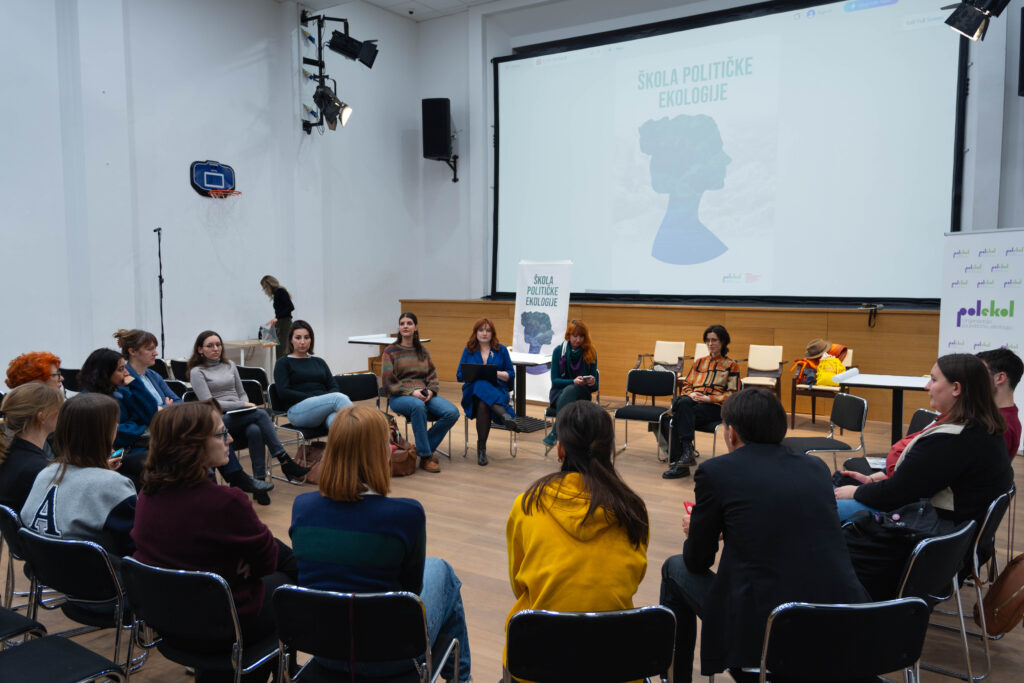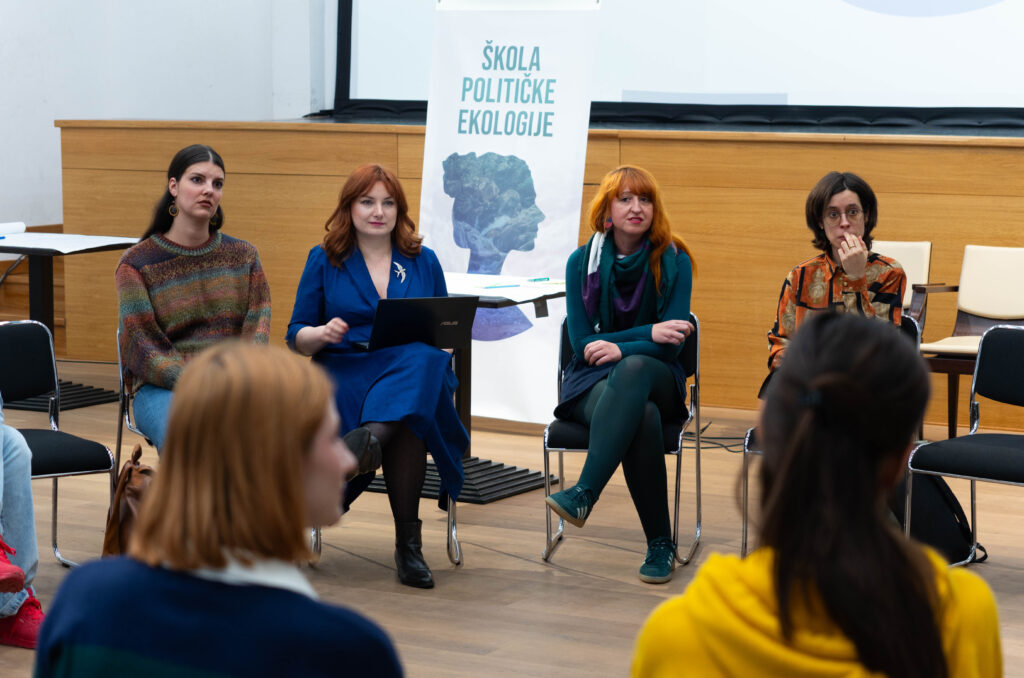


The third public event of the School of Political Ecology was held under the title “Extractivism and Renaissance”. The students of the school, the audience and members of the Organization for Political Ecology – Polekol gathered on this occasion on December 17 at the Czech House in Belgrade.
The lecture on “Extractivism and renaissance” was held by Polekol program director Iva Marković and Polekol researcher Iskra Krstić.
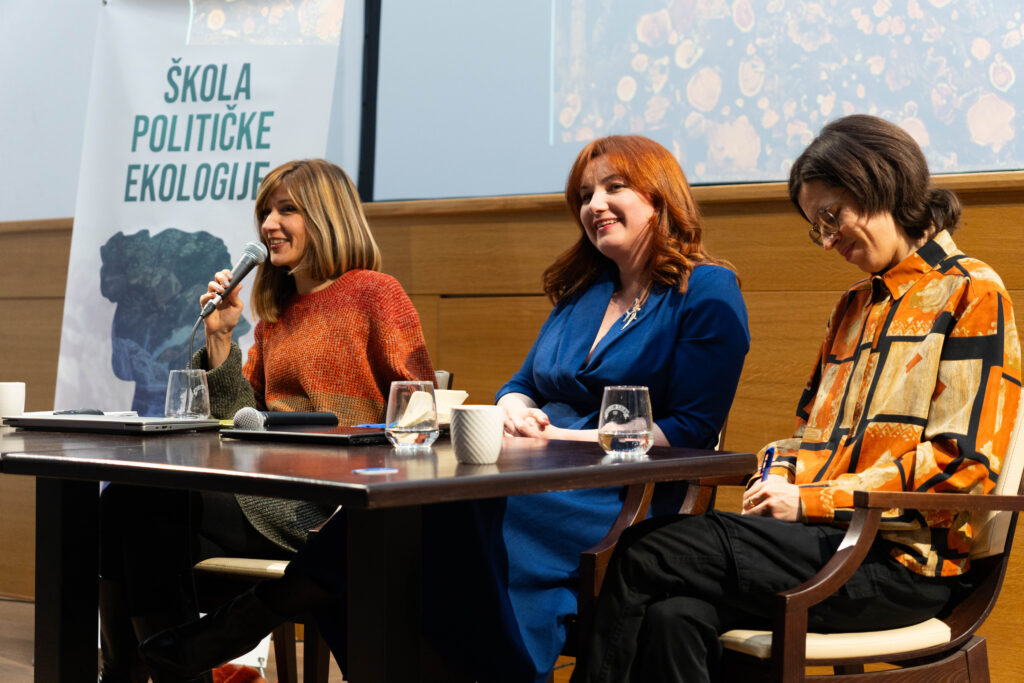
Extractivism includes the practice of extracting resources and their export from countries and regions with less economic, political and military power to more powerful countries and regions, as well as the ideological justification of these processes, the researchers explained, drawing attention to the difference between extraction as a material process and the ideological component of extractivism.
When Polekol organized a conference dedicated to extractivism two years ago, this term was much less used in public discourse, and in the meantime it has become more common, the researcher recalled. “We consider extractivism to be those relationships, processes and ideology that have developed over the past five hundred years, practically since the conquest of Africa and, above all, Latin America by European countries,” the researcher stated.
Extractivism includes both material processes and their ideological justification. “Practically, these are the processes of stealing public goods – or, in the words of the economy, resources – from countries that have less political, military and economic power, and exporting them to countries that have more of this power, under unequal conditions,” explained the researcher. As she emphasized, it develops in parallel with the processes of colonialization and the development of capitalism, and is inseparable from them. As a theoretical term with a critical connotation, extractivism was first used in Latin America.
Krstić stressed that extractivism brings great economic depletion of countries that are rich in resources, while it brings enrichment for countries that import natural goods or resources. According to some studies, the relationship is so unequal that today the global north profits approximately 30% more from the global south than it gives back to the global south in some types of aid.
Both communities and nature are the losers in all of this. “We have to emphasize the scale of extractivist processes. It is important to understand that resource extraction has tripled in the last forty years, and that the UN predicts that it will triple once more by 2050.” In the further course of the lecture, the researcher pointed out the similarities and differences between extractivism and exploitation, and pointed out that the efficiency of resource use has been decreasing since 2000.
Extractivism is an old thing, but it is experiencing its renaissance, stated Iva Marković. She emphasized that extractivism was conceived in conjunction with colonialism, but that today’s extraction does not take place within the framework of the same colonialism, although it is often simplified that way.
“We are not really talking about pure colonialism here, but we have elements of colonial relations. Colonialism had its exact historical moment,” emphasized Marković. According to her, today and in our country, we can use neocolonialism more in the context of comparing the relations of power and coercion, which is an important element of extractivism.
Marković emphasized the ideological component of extractivism, and drew attention to the fact that this term can be applied to a wide range of processes, which, for example, includes the appropriation of intellectual property and the educated population. “So, you can draw some resources from somewhere, in the form of an educated population or some knowledge, in order to exploit them and make a profit somewhere else, and leave the resource area, the community that produced that knowledge, in trouble,” said Marković.
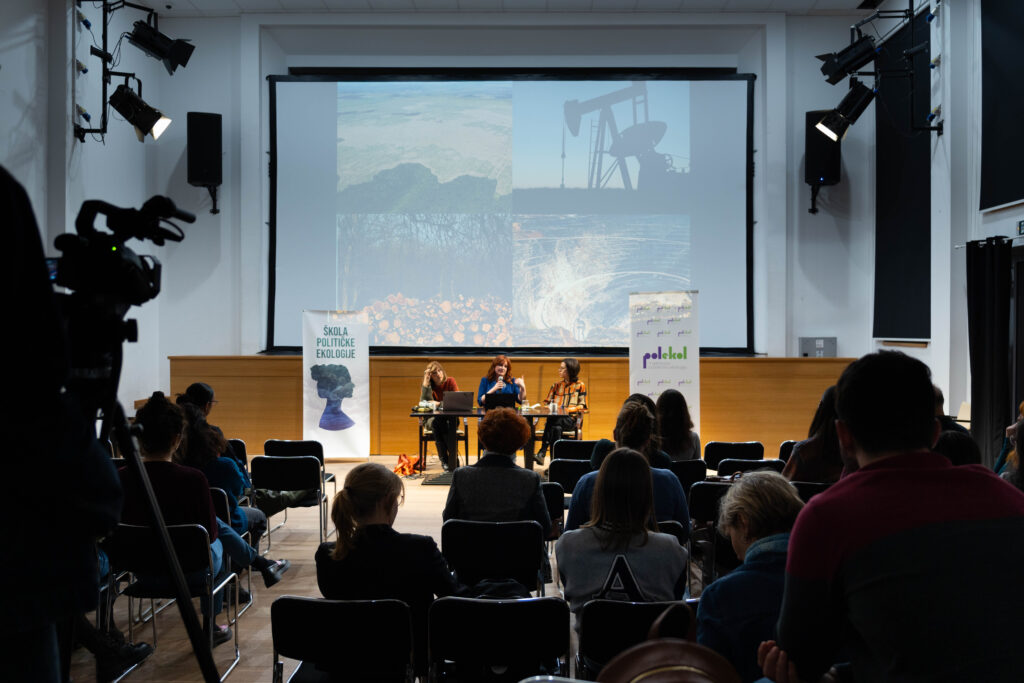
Extractivism can only function in conditions that favor its ideological basis. “It’s always a question of what are the causes and what are the consequences – are we, for example, collapsing our institutions due to extractivist ideology, ruining democratic and public control over resources, or would we not have even thought of extractivism if those conditions had not already been met.” Marković drew attention to the fact that an example of such a collapse of institutions these days can be found in the European Union. “The EU is preparing catastrophic changes in the law for its members. They represent a major setback in relation to what we, as various environmental movements, have barely, painstakingly won.” Marković explained that numerous standards in the field of environmental protection and access to drinking water are being lowered precisely because of mining companies and extractivism. On the other hand, it is worth asking whether extractivism could even exist in practice if we did not already have such fragile institutions and such a fragile democracy.
In the further course of her presentation, Marković emphasized that one of the preconditions of extractivism is large material differences. “So, the mining companies, these biggest ones that we are dealing with, and there are others that have not come so far and that we hope will never come, have budgets that are bigger than the budgets of some countries. These are terribly big inequalities and that is the context when you are fighting against a mining company, for example, a resident, a pensioner in a village.” Extractivism requires that these inequalities be blurred, so that it would appear that all actors have equal rights and all parties have a legitimate interest, Marković pointed out.
The lectures were followed by a discussion, and the evening ended with an informal gathering.
Iva Marković is the program director of the Polekol organization, the founder of the Right to Water initiative and one of the initiators of the Women’s Network for Nature Protection in Serbia and the regional alliance “Let’s defend the nature of the Balkans”. She completed her studies in Environment, Development and Public Policy in Global Studies at the University of Sussex and researches topics such as sustainable natural resource management, environmental political economy, international development, ecofeminism and the social aspects of climate change. It is dedicated to connecting different social movements and developing progressive policies in Serbia and across Europe.
Iskra Krstić is a theoretician of critical urban studies and a researcher at Polekol and Kontekst kolektiv, with experience in journalism. Focusing on uneven and unequal economic and spatial development, he researches spatial and urban planning, housing policies and extractivism. As a member of the Right to Water initiative, she participates in field and media work, as well as cooperation and networking with local, regional and international actors.
We invite everyone who deals with this topic or is interested in it to offer their comments. We look forward to a lively discussion at the end of our first trimester!