


Conflicts, militarization, and the environment were the focus of the second public lecture of the School of Political Ecology, held on December 3, with presentations by researchers Dr. Julie Klinger and Dr. Aleksandar Matković.
The lectures and the accompanying discussion examined how armed conflicts, geopolitical tensions, and the current wave of intensified militarization affect nature and society. Held online via the Zoom platform, this public lecture connected issues of security, geopolitics, and ecology, creating space for reflection on alternatives to militarized approaches to natural and social crises.
“While the impact of armed conflicts on the environment is evident through direct pollution and destruction, there are also vast, less obvious threats in the form of the military industry’s contribution to climate change and the redirection of entire economies toward extractivist industries,” said the event moderator, Iva Marković, Program Director of Polekol, in her opening remarks.
Conflicts, Militarization and Lithium
Dr. Julie Klinger, Associate Professor at the Nelson Institute for Environmental Studies at the University of Wisconsin–Madison, emphasized in her lecture titled “Conflicts, Militarization, and Lithium” the scale of the military industry’s resource demands and highlighted the ways in which the U.S. military conceals its actual consumption of mineral resources.
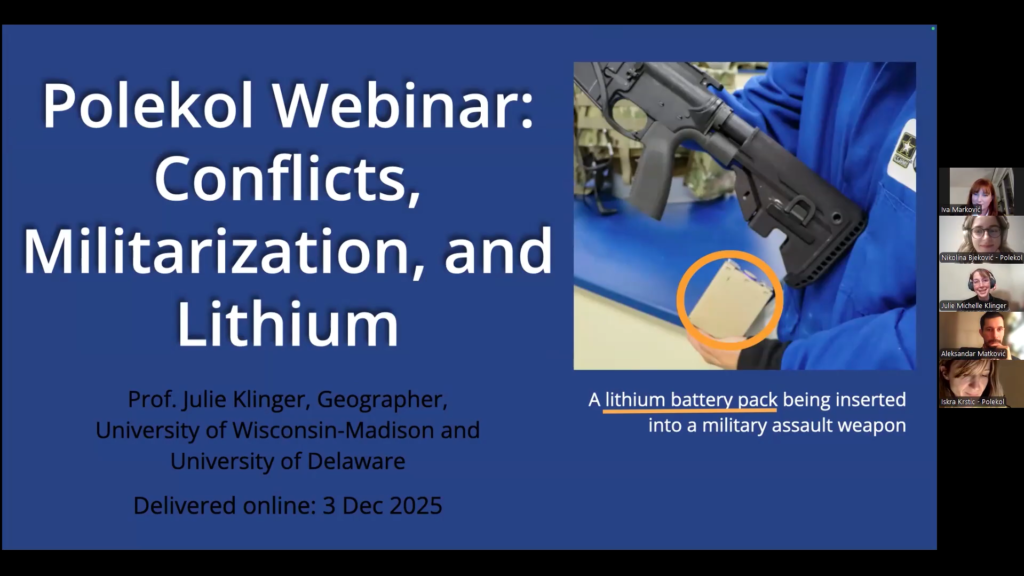
Research on the use of critical minerals in the military industry is growing, but due to the complexity of the system and limitations in data availability, no study is comprehensive, the researcher emphasized. Addressing this issue, Klinger also explained how researchers obtain data—that is, how they track the path of critical raw materials from their deposits to the final product. In this context, she highlighted the significant work of organizations such as the Forum on Arms Trade and the Stockholm International Peace Research Institute (SIPRI). She also pointed out that in the U.S., weapons production and sales are becoming increasingly opaque, as demonstrated by targeted transparency studies.
Klinger also highlighted how the U.S. government is accelerating the issuance of permits for opening mines on domestic territory to meet the needs of the military industry. “Although mining companies strive to present themselves as providers of solutions to the climate crisis and as meeting the demand for renewable energy, at this moment there are no measures in place to ensure that the resources mined for the energy transition are actually used for these purposes,” Klinger concluded.
However, alternatives do exist. One of the four possibilities Klinger mentioned is that, based on existing data, the raw materials needed for the energy transition could be obtained by cleaning up existing waste sites and tailings. “Recycling ninety percent of the waste from existing domestic (U.S.) mining activities could meet nearly the entire demand of the U.S. for critical mineral resources,” Klinger emphasized.
“Finally, one of the best ways to reduce pressure for opening new mines is to decrease the destructive demand for these critical resources and to protect them from destruction in military conflicts. While, on one hand, anti-war and peace movements have been weakened by recent events, on the other, we can be certain that there are material security benefits that come with peacetime, not to mention all the other advantages. Peace is more efficient, peace is less wasteful—fewer mines are needed in times of peace.”
Serbia as a Battleground for European and Chinese Industrial Policies
Dr. Aleksandar Matković, Research Associate at the Department of Economic History and Theory at the Institute of Economic Sciences in Belgrade, as well as a collaborator with the Transnational Institute (TNI), spoke about the trends shaping Serbia’s economic and political position today.
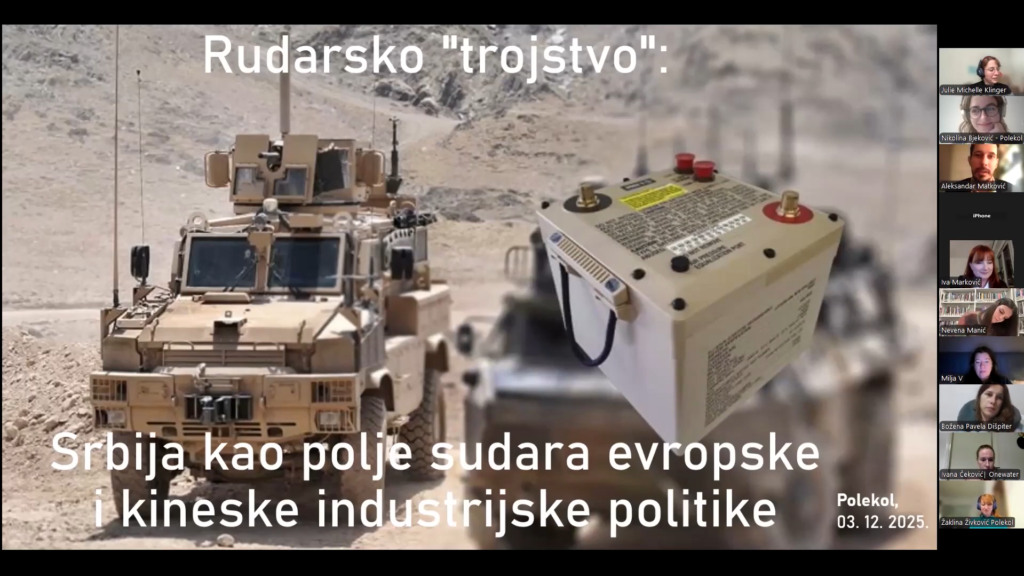
Matković first pointed out that foreign investment in Serbia’s mining sector increased by a staggering 600% between 2017 and 2022. Waste alone grew by almost 150% (149.4%) in 2022, reaching 174.7 million tons, of which 94% was mining waste and 18% hazardous waste. He also emphasized that foreign direct investments in Serbia have been accompanied by high levels of subsidies, which in turn contribute to a growing budget deficit.
Matković identified the relocation of production from China, as well as from the EU—further driven by the militarization of the European Union—as key factors behind these trends. While China exploits the Balkans for mining to facilitate industrial relocation, the European Union has an additional motive: its own militarization. Matković noted that this trend cannot be analyzed without considering analogous processes in the U.S., building on Klinger’s presentation.
Matković noted that the EU will invest the trillions of euros that could have gone into a Green New Deal into a “Clean Industrial Deal,” which he describes as a “right-wing response to the Green Deal.” He also pointed out that since 2006, under the European Battery Directive, the military industry has been exempt from laws that would otherwise require it to provide public access to its operations and comply with pollution limits. Linking this to Julie Klinger’s presentation, Matković observed that this is why we lack data on the actual needs and resource consumption of the EU military.
Matković emphasized that the EU’s militarization is closely linked to the economic crisis, particularly crises in specific sectors such as the automotive industry. He also noted that, regardless of how much states invest in the military, business actors from the East and West are not in conflict but rather cooperate. A clear example of this is the intertwined operations of companies like Zijin and Rio Tinto. Deregulation in Serbia is driven by the U.S. and the EU, while Chinese companies contribute to the cumulative problems in mining. “We have chosen the worst of both worlds,” Matković concluded.
Dr. Julie Klinger’s research focuses on the dynamics of global resource boundaries and space technologies, with a particular emphasis on the United States, China, and Brazil. She investigates how different forms of conflict shape land use, the environment, and the security of livelihoods, as well as how mineral resources are utilized under these circumstances.
In his work, Dr. Aleksandar Matković focuses on how foreign—particularly Chinese—direct investments have shaped today’s Balkans in the context of the global green transition.
The public lecture of the School of Political Ecology, attended by over fifty participants, was held via the Zoom platform. Simultaneous translation into Serbian was provided through a dedicated Zoom channel for the English-language lecture. You can watch the recording of the lecture on conflicts, militarization, and the environment here: